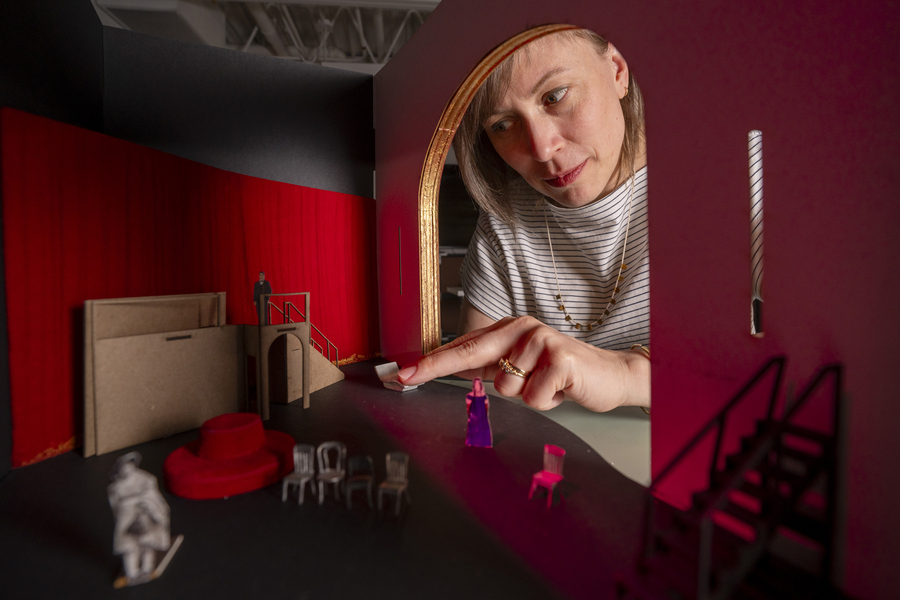
In a theater, the first thing the audience sees, and looks at the longest, is the stage. Even so, set design is something most of us know little about. Why does a set have its form and elements? How does it suit the performance?
Consider a set that designer and MIT Associate Professor Sara Brown created in 2015, when the Brooklyn of Academy of Music adapted the canonical Japanese Noh play “Hagoromo,” turning it into a chamber opera with dance.
Noh plays have a traditional structure and a crucial final transformation. In “Hagomoro,” an angel loses her cloak; a fisherman only reluctantly returns it, after the angel performs a ritual dance; the angel then ascends to the heavens. To focus on the main characters, Brown’s design featured three high walls surrounding center stage, with musicians and a chorus elevated behind them.
“That set was a framing device more than anything else,” says Brown, who is also associate head of MIT’s Music and Theater Arts program. “It lifted the musicians to a different plane, almost a heavenly place, so we have a heaven-and-Earth contrast. It allows the dancers to be seen against a plain backdrop. I didn’t want to lose their bodies in a sea of other bodies.”
For a formal play structure, then, Brown created a formal setting, with vertical layering suggestive of its contents. The trickiest part was lighting: Brown worked with the lighting designer Clifton Taylor to cut vents in the high walls for more light, while a rigging structure allowed them to spotlight dancers.
“Solving for those things is what makes the design,” Brown says. “There’s an artistic idea that underbeds everything, and there are practical considerations, which are as important, to make the piece work the way you want.”
Brown has designed sets at many major venues, tackling everything from “Carmen” to “Death of a Salesman” and debut productions. She ranges broadly across theatrical genres, while teaching classes that get MIT students thinking visually, intellectually, and creatively.
“Every play you’re working on should have something you grab onto as a creative challenge,” Brown says. That challenge is a collective one; it involves working with directors, performers, and design teams focused on lighting, sound, media, and costumes.
“In theater-making, you have to work in a community,” Brown emphasizes. “You might bump up against some rough edges, but you develop strategies to work with everybody with dignity, and that’s important.”
For her extensive work and teaching, Brown received tenure at MIT last year.