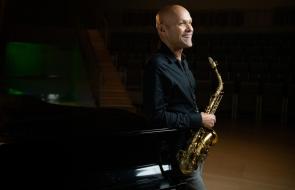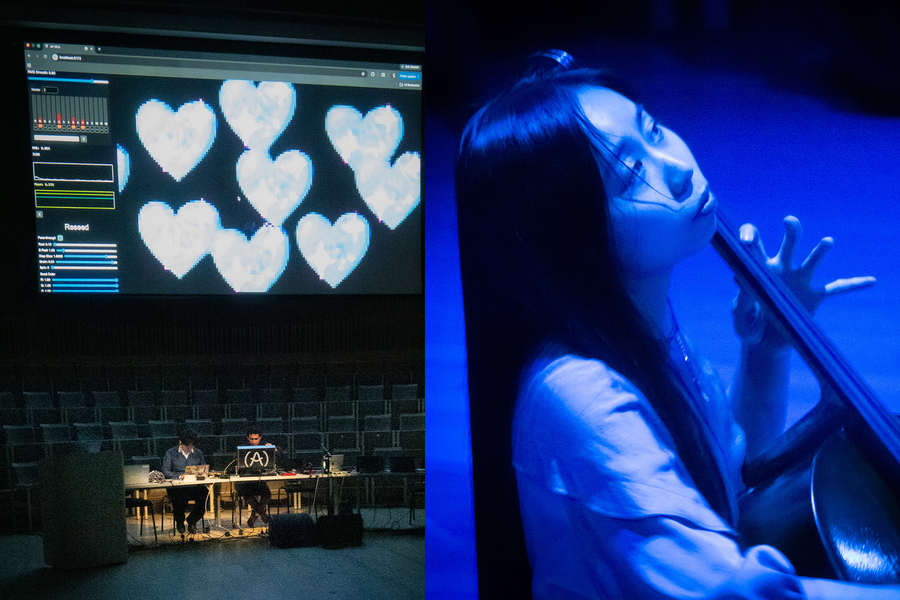
The MIT Music Technology and Computation (MTC) Graduate Program — launched in fall 2024 as a collaboration between the Music and Theater Arts Section in the School of Humanities, Arts, and Social Sciences (SHASS), and the School of Engineering (SoE) — presented its inaugural MIT Music Technology Research Showcase on May 13. The event played to a standing room-only house in the Edward and Joyce Linde Music Building’s Thomas Tull Concert Hall and featured diverse and captivating research presentations and music performances.
The celebratory occasion featured MTC’s first five enrollees (all of whom were previously MIT undergraduates), alongside several PhD students and faculty. Each scholar presented inspiring exemplars of artful engineering that reflected the broader and burgeoning music technology scene at MIT.
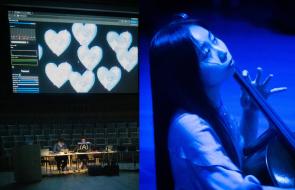
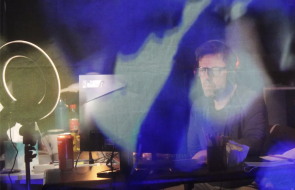
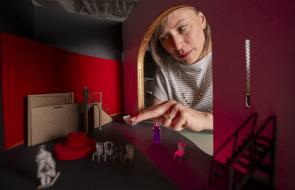
The 90-minute event exhibited a broad array of research projects, including a real-time visualization of what an AI co-improvising agent is about to play on a piano; a sound-art installation based on noisy network communication; a hip-hop dance circle where music is generated from dancing; and the use of electroencephalogram (EEG) signals to identify the musical tunes that our brains are imagining.
“A new space for exploration and insights”
An interplay of technical presentation with live performance, the showcase began with remarks from SHASS Dean and professor of philosophy Agustín Rayo, SOE Dean and professor of chemical engineering Paula Hammond, and MTC Director and professor of the practice of music Eran Egozy.
Rayo began, “The goal of this program is simple — for MIT to lead the world in music technology theory and application,” adding “it’s not just about making music with technology; it’s also about working across disciplines to help better shape the future of expression in an AI-driven world, all while reflecting MIT at its best.”
Rayo noted the graduate program was made possible in part by the opening of the Edward and Joyce Linde Music Building in 2025, which provided new classrooms, studios, rehearsal spaces, and a dedicated music technology lab. He also credited the MIT Schwarzman College of Computing for its support for the graduate program.
Hammond followed: “As those in this room already know, music and engineering share some common roots. Both rely on mathematical precision and are informed by defined structures, rhythms, and frequencies. Both demand hard work and technical know-how, paired with inspiration and imagination, to create something entirely new. Given those congruities, it’s no surprise that so many faculty, students, and staff members across MIT are also accomplished musicians and artists.”
She continued, “Our music program is a gem. Only at MIT could we bring the top technologists and the top musicians together to create unique opportunities for collaboration. Here we have brought together faculty and students who identify strongly with both music and engineering to form a new space for exploration and insights. It’s a strong example of the collaborative culture that defines the Institute.”
Egozy called the event a “harmonious hybrid of concert and symposium,” and recollected, “it’s a little mind-boggling to see what our students have achieved in just one short and fast-paced year. While we originally debated the trade-offs between a one-year and a two-year master’s program, I think this cohort really showed us that we can make huge strides in learning and research abilities in a concentrated period of time.”